
By Dr. Mark A. Stebnicki
Disclosure: This article was drafted with the aid of generative AI using content from our proprietary courses. It has undergone extensive review, editing, and has been verified for accuracy by Dr. Mark A. Stebnicki.
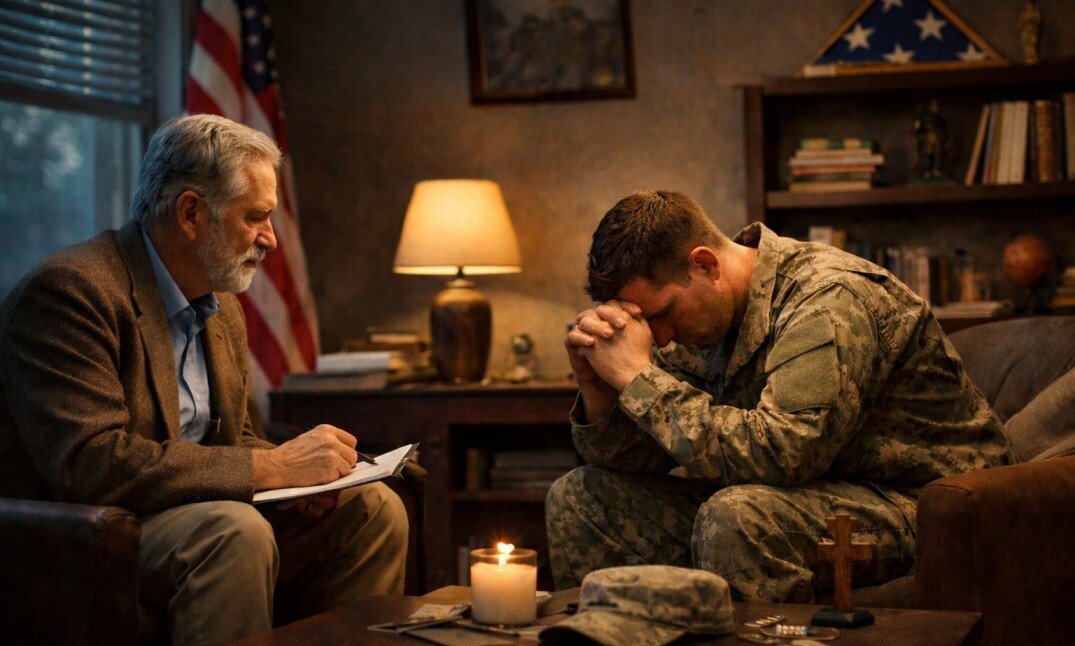
This article will assist clinical military mental health counselors to recognize, describe, and screen for moral injury among active duty service members and veteran clients. The clinically significant characteristics and assessment of moral injury and psychospiritual crises sometimes are not well defined within therapeutic settings. This is because trauma exposure from warfighting, humanitarian deployments in austere environments, and general military service for some, results in a deep inner psychospiritual wound that leaves scars on the mind, body, and spirit of clients that have served.
In my clinical work with active duty service members, veterans, veterans with disabilities, and military families, I have often found myself sitting with client experiences that do not neatly fit within a DSM-5-TR diagnostic category. Military clients, particularly those with combat-operational stress, describe their distress similar to the clinically significant symptoms of posttraumatic stress, depression, anxiety, loss, and/or grief. Despite that these are clinically distressing symptoms and are readily identifiable, the etiology may be directly related to issues surrounding moral injury, psychospiritual, and/or existential crises. This is commonly observed among combat veterans that are transitioning and reintegrating into civilian life. Moral injury does not impact all combat veterans. However, as service members and veterans begin to lose meaning, identity, and purpose in life, this warrants clinical attention.
When clinicians rely solely on conventional clinical diagnostic categories, issues related to moral wounding may become lost in interpretation as military clients attempt to communicate the ambiguous nature of the distress they experienced during military service. Most service members and veterans do not know how to describe their experience of moral injury. So, the therapist may document the military client’s level, intensity, and frequency of the clinically distressing symptoms. However, there may be missed therapeutic opportunities if both client and therapist view this soul wounding experience as “the fog of war.” Accordingly, this does not quite capture ones’ experience of moral injury, existential and/or psychospiritual crises. Overall, critical events associated with military service may become viewed by therapists as complex trauma, with additional clinical features related to prolonged grief, depression, and/or anxiety disorder. Rationally it makes sense because moral injury is not a diagnostic category contained within the DSM-5-TR. Despite mandates to provide a standard CPT code for therapy, the clinically significant symptoms may have occurred as a direct result of a particular deployment and post-deployment reaction. Thus, moral injury may become overlooked by some therapists.
Competent clinical military counselors facilitate a comprehensive assessment of combat related exposure and other unwanted military service experiences. For example, the following questions may be essential to ask such as: Were any unit members seriously injured or killed in action or combat training? Were you deployed in a humanitarian austere environment or combat mission? Were you required to engage with enemy combatants? Have you ever been surrounded by enemy combatants? Blown up? Have you witnessed the death or serious injury of a unit buddy close to you? Have you ever encountered unwanted sexual advances or sexual assault? Each of these examples of critical incidents have a unique meaning. It may be difficult for service members and veterans to communicate their soul wounding experiences. However, clinically competent military counselors are aware of the nature of the military as an occupation and the range of medical, physical, psychological, and psychospiritual injuries that may occur.
💡 When Distress Becomes an Invisible Wound: Screening for Moral Injury
Military mental health researchers suggest that many military service members, pre-enlistment, have been treated successfully for a range of mental health conditions. Thus, there may be some preexisting mental health characteristics that were triggered during military service. These issues may have become unresolved especially during transition and reintegration to civilian life. Despite the fact that some active duty service members and veterans were screened, assessed, or diagnosed with a mental health condition during post-deployment or transition into civilian life, their condition(s) may have been unrecognized, not diagnosed or documented as a disorder, untreated, or undertreated. This can result in very little therapeutic opportunity for healing the mind, body, and spirit. Thus begins the cycle of complex posttraumatic stress which may morph into an invisible moral, existential, an/or psychospiritual wounding experience.
Most definitions of moral injury are the invisible wounds that often become visible from a medical, physical, psychological, and psychospiritual crises viewpoint. Moral injury shows up when a person believes they have violated, perpetrated, failed to prevent, or witnessed an act of inhumanity. Within the context of the military, these experiences often occur under conditions where the service member’s choice is constrained by mission requirements, chain of command, or the realities of warfighting. Accordingly, if these traumatic experiences are left unrecognized, untreated, or undertreated they become significant unresolved issues in therapy. Thus, clinical military counselors should consider the service member or veteran’s experience of moral injury, existential, and/or psychospiritual crises. Mostly, it is essential to know how to open a conversation with your military clients after you have earned the circle of trust with them.
The following is offered as an abbreviated list of common themes and clinically significant symptoms that merit follow up in the evaluation and screening of your service member and veterans’ experience of moral injury:
Feelings and experiences of shame, guilt, anger towards self and others in witnessing or perpetrating the injury or death related to civilian children, adults, and conscripted enemy combatants.
Non-disclosure (due to operational security issues) to others outside the special operations unit of critical events related to injuring and killing enemy and non-enemy combatants, torture, rape, and other traumas witnessed or perpetrated by the client.
Disassociation, rejection, repression, or denial of traumatic events witnessed or perpetrated during combat operations or humanitarian missions.
Loss of meaning of self, with the increased experiences of guilt, shame, failure as a human being.
Decreased ability to feel a sense of forgiveness by self and others, for engaging in, or completing a mission that resulted in injury, death, and other horrors of war.
Loss of meaning and/or feelings of disgust with ones’ military career, occupational specialty, mission purpose, and overall military life.
Questioning of combat-related orders, the mission, and distrust of unit and command leadership.
Feelings of personal failure and operational failure that manifests as guilt, shame, and moral concerns.
Struggles with and loss of religious faith and spiritual practices that lead to a soul wounding experience.
Manifestation of clinically significant symptoms related to the diagnostic categories of posttraumatic stress, anxiety, depression, and substance use disorders, as well as suicidality.
🧾 Listening for Military Client’s Soul Wounding Experience of Moral Injury
Healing the mind, body, and spirit of moral injury can be a transformative experience for many military clients. Moral injury is typically prompted by the language of the therapist. Rarely do clients report in session, “I think that I have a moral injury.” Rather, they provide some context for this ambiguous experience as noted in the items above. This then becomes the language of client and therapist which opens doors for therapeutic opportunities to try and put into words any unwanted and unhealthy thoughts, feelings, behaviors, and actions.
Oftentimes, I pay close attention when clients repeatedly revisit a critical incident that reflects unresolved thoughts, feelings, behaviors, and actions. I listen to my client’s language that reflects a ruminating inner dialogue such as “I should have-could have-would have done things differently”, “This is all my fault”, "I feel guilty because I am the survivor here”, and/or “I let everyone down.” These significant statements point toward unresolved moral appraisal of oneself and should not solely be taken within the context of the clinical characteristics of posttraumatic memories or simply unresolved prolonged grief.
Another signal emerges when clients struggle with forgiveness—either toward themselves or others. They may express anger toward unit members, military leadership, the system, or themselves. This is often intertwined with a sense of obligation to remain loyal as a military service member or veteran. That tension between loyalty and resentment is common in military culture and deserves careful handling. At times, saying “thank you for your service” can be perceived as disingenuous and trigger other hurtful and harmful reactions by military clients.
Rather than correcting these narratives or reframing them prematurely, I maintain my curiosity. I ask what those moments mean to my client now, how they see themselves, and what mission values feel most impacted. This approach respects the client’s internal moral structure that is rich in emotions, cognitions, self-esteem, and psychospiritual identity all of which help determine the adjustment and adaptation process post-deployment as well as during transition.
🔄 Integrating Moral Injury Throughout Treatment
Addressing moral injury does not replace other therapeutic interventions. Rather, it complements them. Many military clients benefit from therapeutic work that supports wellness approaches such as regulation of mood and affect, sleep, substance use, and dealing with interpersonal and intimate relationships. Moral injury can be addressed alongside these therapeutic goals. In practice, this may involve revisiting a military client’s life narrative that helps identify meaning within the mission. For some, transition is the mission. For others, it may be working therapeutically with unresolved prolonged grief. Overall, it is essential to encourage your military clients to tell their stories in a safe environment. Progress is rarely linear. It is dynamic in nature. Clinical military counselors allow their military clients time for adjustment and adaptation. They assist clients with recognizing how they may move between insight, grief, anger, and moments of adjustment and adaptation with the intention of achieving optimal reintegration.
📚 Further Learning
What we’ve covered here is a foundation for understanding moral injury and its relevance in clinical work with military clients. For clinicians who want a more comprehensive framework, advanced applications, and continuing education credit, the Clinical Military Counseling Certificate Program (CMCC) offered through the Telehealth Certification Institute provides in-depth training on these topics.
The program examines moral injury within the broader context of military culture, complex trauma, and psychospiritual meaning-making. It includes case-based teaching, interviews with service members and family members, and structured guidance on ethical and clinical considerations across the deployment cycle.
I developed this program drawing on more than three decades of clinical practice, counselor education, and direct work with military populations, as well as my published work on clinical military counseling and empathy fatigue.
✅ Conclusion
Moral injury challenges us to expand how we listen to our military clients. It reminds us that not all suffering can be measured by symptom checklists or facilitating therapeutic techniques alone. Soul wounding experiences can be witnessed, understood, and integrated into military clients’ ongoing stories. Overall, the search for meaning in one’s military career is an existential and spiritual pursuit. Moral injury is an invisible soul wounding experience with some military members. This unique form of distress should merit clinical attention for optimal care of the mind, body, and spirit.