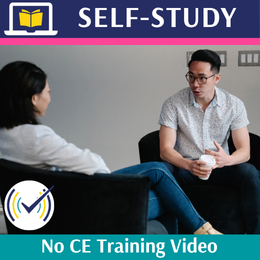
Communication Theories and Strategies for Therapists
Payment Options: Credit Card, PayPal, Venmo, or Pay Later (4 payments)
Rewards: You earn 10% on all of your orders towards your next purchase.
The add to cart button will appear once you select the values above
Specifications
This course does not offer CE Credits. The same course is available for purchase and offers 3 clinical CE hours for behavioral health clinicians. See "related products" below. When a client’s story breaks down, the nervous system keeps talking. You hear it in the clipped pace, the half-started sentences, the sudden whisper when abuse is named, the jokes that dodge grief, the long stare that isn’t “resistance” so much as a body bracing for impact. This training shows you how to hear all of it—and how to respond in ways that settle, clarify, and move the work forward. Strengthening your grasp of how meaning is made in conversation—words, tone, timing, breath, silence—can transform sessions. Whether you’re seeing the same patterns repeat in client relationships or you want to respond more effectively to emotional cues in the room (or on screen), this course helps you move from recognition to confident, compassionate action. Dr. Corey Petersen, PhD, LCMFT, is a psychotherapist, continuing-education trainer, and communication scholar with more than a decade in the clinic and classroom. Her background spans Communication Studies, Marriage & Family Therapy, and applied consultation—bringing a rare blend of theoretical depth and hands-on clinical judgment to this training. You’ll learn to spot trauma language (linguistic numbing, “speechless terror,” temporal disruptions), track paralinguistic markers (pitch shifts, pressured or flattened prosody), and use your own affect intentionally for co-regulation and safety. You’ll also connect core communication theories—Structuration, Fantasy Theme (Symbolic Convergence), and Facework—to everyday clinical dilemmas like repeating relational patterns, stuck conflict cycles, “good client” masking, and shame. With a dynamic, accessible teaching style, Dr. Petersen begins by establishing a crucial foundation in the axioms of communication—essential theory often missed in traditional psychotherapy training. This theory-intensive course then advances to the realities of stress-and-trauma expression and the application of advanced theories. Expect precise definitions, memorable clinical examples, and consent-based, trauma-aware prompts you can borrow verbatim. You’ll leave with sharper ears, steadier presence, and language that helps clients feel understood without flooding. Spot and respond to trauma-shaped communication in real time—verbal (numbing, false starts, looping) and paralinguistic (pitch, pace, breath, volume). Use your own affect as an intervention—breath/cadence matching, micro-validations, and steady presence—to co-regulate and keep processing safe. Apply Structuration, Fantasy Theme, and Facework to unstick recurring dynamics and reshape client narratives without rescuing or overwhelming. Translates complex communication science into frameworks for deeper clinical analysis and session-ready understanding. Grounded in trauma-informed practice with clear markers for when to slow, validate, redirect, or contain. Taught by a clinician-scholar who bridges theory and real-world therapy with memorable examples and scripts. By the end of this training, participants will be able to: Describe core principles of Facework Theory, Structuration Theory, Communication Privacy Management Theory, Relational Dialectics Theory, and Fantasy Theme Theory. Demonstrate discussions with clients about shared narratives, systemic patterns, and the management of relational tensions. Identify verbal and nonverbal communication patterns commonly seen in trauma survivors, including paralinguistic markers. Determine the impact of the therapist’s affect on the processing of trauma narratives and therapeutic outcomes. By deepening how you listen—to words, bodies, and the space between—you’ll expand what becomes possible in the room: steadier alliances, clearer formulations, and conversations that heal rather than harden. Ready to translate subtle moments into therapeutic momentum? Enroll today and start applying these skills in your very next session. Format and Access This is a Non-interactive, self-study course. Instruction consists of 3 hours of on-demand video and an evaluation. From the time of registration, you have six months to access the coursework. This course is intended for clinicians who provide behavioral health services. This continuing education course is designed for licensed behavioral health professionals. This is a non-interactive, self-study course. Teaching methods for this course include recorded lectures, videos, a post-test, and a course evaluation. Course access and completion instructions. Dr. Corey Petersen is a communication specialist and the owner of Communication and Connection Therapy. She completed her Ph.D. in Communication Studies at the University of Kansas, where her research focused on psychotherapeutic language and communication ethics. Prior to her Ph.D., Dr. Petersen earned a Master’s degree in Marriage and Family Studies and Professional Communication. She has over 9 years of collegiate communication and psychology teaching experience and is currently a continuing education and corporate trainer. When not teaching, Dr. Petersen can be found working and meeting with clients in her private practice. The instructor(s) for this course receive compensation for their services. There are no reported conflicts of interest to disclose. This course does not offer CE credits, just great content. The same course is available for purchase and offers 3 CE hours for behavioral health clinicians. See "related products" below. This course is a non-interactive, online self-study. Participants may request a printed version of their certificate of completion to be delivered by mail. A shipping/handling fee of $6.95 will be charged per request. Shipping internationally may require an additional charge. Close Captioning is available for live webinars and recorded video presentations. You can click on the following links to view our policies:Description
Key Takeaways:
Why this course?
Learning Objectives:
Course Details
Availability:
Who Should Attend:
Teaching Methods:
How to Attend:
Instructor and Disclosures
Instruction

Corey Petersen, MA, MS, Ph.D, LCMFT
Disclosure Statement:
CE Hours
Accommodations and Policies
This course was recorded 8/8/2025
Related products

Testimonials
Iveyana Kiara Smith
Jessy Hainbach
Bryant Wilson
Ben Keyser
Mei Chan
Meghan Co, LCSW-C, LICSW