
Play Therapy for School-Related Anxiety, School Phobia, and School Refusal
Payment Options: Credit Card, PayPal, Venmo, or Pay Later (4 payments)
Rewards: You earn 10% on all of your orders towards your next purchase.
The add to cart button will appear once you select the values above
Specifications
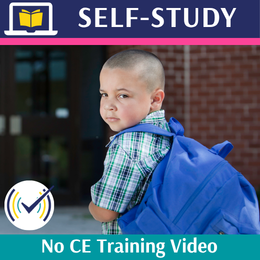
This course does not offer CE Credits. The same course is available for purchase and offers 3 CE hours for behavioral health clinicians and play therapists. See "related products" below. School refusal isn’t always about defiance—it can be a cry for help. For many children, the refusal to attend school signals a deeper emotional struggle, one rooted in anxiety, trauma, or a perceived lack of safety. Behavioral health professionals are on the front lines of decoding and addressing these challenges. This course empowers clinicians with the knowledge, tools, and confidence to intervene effectively—restoring stability, connection, and hope for children and families navigating the hidden complexities of school-related anxiety and avoidance. Kris Marowski, M.Ed., LPC, RPT-S, ACS, CCMHC, NCC brings over 16 years of experience as a Licensed Professional Counselor and Registered Play Therapist Supervisor. Her specialized work with children affected by trauma, divorce, military and first responder families uniquely equips her to guide clinicians through the nuanced process of identifying, assessing, and treating school refusal behavior through the lens of play therapy. Drawing from a child-centered and trauma-informed approach, Kris integrates existential, Jungian, and cognitive behavioral techniques to teach clinicians how to engage children meaningfully while supporting their caregivers. Her clinical wisdom, personal case examples, and structured tools make this course both inspiring and immediately useful. Topics covered include understanding the terminology used across educational and clinical settings, recognizing early warning signs and diagnostic criteria, utilizing screening questions and intake methods, applying the DSM-5 framework, and choosing play-based assessment tools. Participants will also learn about intervention strategies that promote regulation and safety, IEP/504 recommendations, and effective collaboration with parents and schools. If you're ready to help kids feel safe again—and guide their families through some of their most difficult moments—this course offers the clinical guidance and real-world tools to make that possible. Your next client is counting on it. Add this course to your cart to develop your skills, boost your confidence, and enhance your impact as a behavioral health professional. This is a non-interactive, self-study course. Instruction consists of 3 hours of video instruction and an evaluation. From the time of registration, you have six months to access the coursework. This course is intended for clinicians who provide behavioral health services. This continuing education course is designed for licensed behavioral health professionals and provides training in suicide prevention using expressive arts as an integrative approach. However, this is not a creative arts therapy course and does not provide training in creative arts therapy. This is a non-interactive, self-study course. Teaching methods for this course include recorded lectures, videos, a post-test, and a course evaluation. Course access and completion instructions. Kris Marowski is a Licensed Professional Counselor and Registered Play Therapist Supervisor. She has worked with children, adolescents and families for over 16 years, providing play therapy, individual counseling, and family counseling. She specializes in working with children that have survived trauma. Kris has extensive experience working with children whose parents are separated or are divorcing, who serve in the military and/or who are first responders. Kris offers parents specific, tangible skills that they can utilize at home to create desired changes and connect with their children in a more meaningful way. She practices primarily from a child-centered perspective, incorporating Jungian, Existential, and Cognitive Behavioral approaches to increase the effectiveness of counseling. She provides a safe, supportive environment where parents, children, and adolescents can process through difficult life experiences and develop a sense of mastery over them. Kris completed her Bachelor of Arts (B.A) in Psychology from Elmira College in 1999 and earned a Masters of Education Degree (M.Ed) in Counseling and Human Development with a specialization in Mental Health Counseling from Lindsey Wilson College in 2005. She went on to become credentialed as a Nationally Certified Counselor (NCC) and Certified Clinical Mental Health Counselor (CCMHC) while completing her Play Therapy certification. Kris is currently working toward becoming a Sandplay Practitioner through Sandplay Therapists of America. The instructor(s) for this course receive compensation for their services. There are no reported conflicts of interest to disclose. This course does not offer CE credits, just great content. The same course is available for purchase and offers 3 CE hours for behavioral health clinicians and play therapists. See "related products" below. This course is a non-interactive, online self-study. Participants may request a printed version of their certificate of completion to be delivered by mail. A shipping/handling fee of $6.95 will be charged per request. Shipping internationally may require an additional charge. Close Captioning is available for live webinars and recorded video presentations. You can click on the following links to view our policies:Description
Key Takeaways:
Why this course?
Learning Objectives:
Format and Access
Course Details
Availability:
Who Should Attend:
Teaching Methods:
How to Attend:
Instructor and Disclosures
Instructor
About Kris Marowski, M.Ed., LPC, RPT-S, ACS, CCMHC, NCC
Disclosure Statement:
CE Hours
Accommodations and Policies
This course was recorded 8/20/21
Related products

Testimonials
Iveyana Kiara Smith
Jessy Hainbach
Bryant Wilson
Ben Keyser
Mei Chan
Meghan Co, LCSW-C, LICSW