The Algorithm Will See You Now: How AI is Re-Writing Therapy With Couples and Families
Enroll in the Online Self-Study and complete the training on your own schedule.
2 CE hours available for behavioral health clinicians completing the Online Self-Study
Artificial Intelligence is no longer a distant or hypothetical issue for behavioral health professionals. Clients may already be using AI tools to seek support, confirm their perspectives, interpret relationship conflict, track symptoms, or question clinical recommendations. At the same time, therapists, agencies, EHR systems, and healthcare organizations are beginning to use AI for documentation, assessment support, treatment planning, workflow, and communication.
For clinicians who work with couples and families, these developments raise especially complex questions. AI may increase access, speed, and convenience, but it can also introduce new risks around privacy, bias, crisis response, relational dependency, misinformation, informed consent, and the therapeutic alliance. Behavioral health professionals need more than curiosity or caution; they need a grounded way to think critically about when AI may be useful, when it may be harmful, and how it affects the relational systems already present in clinical work.
Register for the 2 CE Online Self-Study for $60
Payment Options are listed at checkout
Register for the 0 CE Training Video for $30
Payment Options are listed at checkout
Dr. Katherine Hertlein, Ph.D., LMFT, brings extensive expertise in couple and family therapy, telebehavioral health, and the impact of technology on intimate relationships and clinical practice. A professor and associate dean at Wright State University’s Boonshoft School of Medicine, Dr. Hertlein has authored widely on technology, relationships, telehealth ethics, and couple and family therapy, and currently serves as editor-in-chief of the Journal of Couple & Relationship Therapy. Her background positions her to help clinicians examine AI not only as a tool, but as a relational, ethical, and systemic force in therapy.
Rather than presenting AI as either a threat to avoid or a solution to adopt uncritically, this course encourages careful clinical discernment. Dr. Hertlein explains foundational AI concepts in accessible language, including large language models, conversational AI, algorithms, machine learning, and the limitations of systems that can appear responsive without being current, emotional, unbiased, clinically intelligent, or appropriate for crisis care. She also highlights how AI tools are shaped by the data and assumptions used to build them, which can affect the reliability, cultural responsiveness, and safety of the information they provide.
Dr. Hertlein helps clinicians move beyond simply asking whether AI is helpful or harmful and instead consider how these tools are already shaping clinical work, client expectations, and therapeutic relationships. The training emphasizes the importance of understanding what problem an AI tool is being used to solve, how its use may affect privacy, informed consent, cultural responsiveness, and relational dynamics, and why clinical judgment remains essential. Rather than positioning AI as a replacement for therapy, the course frames it as an emerging tool that requires thoughtful integration, ongoing learning, and careful attention to preserving the human relationship at the center of care.
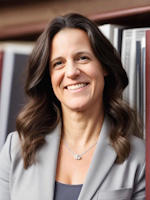
Instructor
Katherine Hertlein, Ph.D., LMFT
Dr. Katherine M. Hertlein, Ph.D., LMFT, is Professor and Associate Dean for Faculty Affairs and Professional Development in the Boonshoft School of Medicine’s Psychiatry Department at Wright State University. Formerly, she led the Couple and Family Therapy Program at UNLV’s School of Medicine. Dr. Hertlein earned her M.S. in Marriage and Family Therapy from Purdue University Calumet and her Ph.D. in Human Development (specializing in Marriage and Family Therapy) from Virginia Tech. A pioneer in the emerging field of Couple and Family Technology (CFT), she co-developed the first multitheoretical CFT framework, addressing how digital technologies influence intimate relationships and therapeutic practice she has authored 100+ journal articles, 50+ book chapters, and 12 books, including Digital Dwelling and The Couple and Family Technology Framework: Intimate Relationships in a Digital Age Her work spans key topics such as online infidelity, gaming, and telehealth ethics and best practices. Dr. Hertlein’s contributions have earned her prestigious awards: Nevada’s Regent’s Rising Researcher Award, Barrick Scholar recognitions, awards from the American Association for Sexuality Educators, Counselors, and Therapists, and a 2018–19 Fulbright Core Scholar appointment in Salzburg, Austria, She currently serves as Editor‑in‑Chief of the Journal of Couple and Relationship Therapy and is a sought-after speaker on technology’s impact in therapy.
Key Takeaways
- AI is already part of the clinical context: Clients may use AI to seek support, interpret conflict, or challenge clinical recommendations, even when the therapist has not introduced it.
- Clinical judgment remains essential: AI can generate suggestions, summaries, or possible interpretations, but it cannot fully understand context, motivation, nonverbal information, relational dynamics, or safety concerns.
- Ethical risks require active attention: Privacy, bias, informed consent, crisis response, data ownership, transparency, and responsibility for harm must be considered before using AI in practice.
- Systemic work adds unique complexity: Couples and families raise additional concerns about shared data, competing perspectives, relational dependency, and the possibility of AI being used to reinforce one person’s position.
- Responsible integration starts with purpose: Clinicians benefit from asking what problem an AI tool is meant to solve, whether it truly supports client care, and how its use affects the therapeutic relationship.
Why This Course?
- Clinically relevant guidance: The training addresses real situations clinicians are likely to encounter as clients and organizations increasingly use AI tools.
- A balanced perspective: Dr. Hertlein presents both potential benefits and meaningful cautions, avoiding simplistic claims that AI is either inherently helpful or inherently harmful.
- Useful across behavioral health disciplines: While grounded in couple and family therapy, the course speaks to broader clinical, ethical, relational, and practice-management questions relevant to counselors, social workers, psychologists, marriage and family therapists, supervisors, and other behavioral health professionals.
- Practical decision-making support: Clinicians gain language and considerations for discussing AI use with clients, evaluating risks, and thinking through documentation, EHR, consent, and between-session use.
- Attention to the therapeutic relationship: The course keeps the human relationship, clinical attunement, and systemic context at the center of decisions about technology.
Learning Objectives
- List foundational knowledge of Artificial Intelligence relevant to the practice of therapy for couples and families.
- Develop critical thinking about the ethical, relational, and systemic impacts of Artificial Intelligence tools.
- Integrate Artificial Intelligence safely and effectively into clinical practice.
AI is changing the questions clinicians must ask about privacy, relationship, access, documentation, and client care. Register to explore how behavioral health professionals can approach these tools with greater clarity, caution, and clinical purpose while continuing to protect the relational foundation of therapy.
Select each tab for course details
Availability:
From the time of registration, you have six months to access the coursework.
Who Should Attend:
This course is intended for clinicians who provide behavioral health services.
Teaching Methods:
This is a non-interactive, self-study course. Teaching methods for this course include recorded lectures, videos, a post-test, and a course evaluation.
How to attend:
Directions for completing a course can be found by clicking here.
This program was recorded on October 31, 2025.
Testimonials
Iveyana Kiara Smith
Jessy Hainbach
Bryant Wilson
Ben Keyser
Mei Chan
Meghan Co, LCSW-C, LICSW