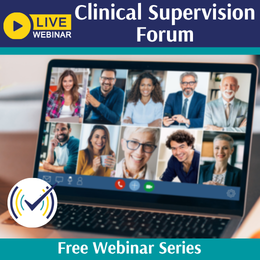
Clinical Supervision Forum
*
Payment Options: Credit Card, PayPal, Venmo, or Pay Later (4 payments)
Rewards: You earn 10% on all of your orders towards your next purchase.
The add to cart button will appear once you select the values above
Specifications
An every-other-month continuing education series -- a free forum for clinical supervisors to learn, network, and share historical and innovative practices in clinical supervision for mental health professionals. The focus will include a combination of theory and practice. Each month an expert supervisor will facilitate a lecture and discussion. Guest presenters will include allied professionals representing counseling, clinical social work, marriage and family therapy, and psychology. Continuing Education credits will be offered for behavioral health clinicians. Live, interactive webinars will be hosted on the following dates: Join us for a LIVE online webinar on posted Fridays from 1:00-2:30pm Eastern time Registration closes for each event at midnight the night before. Clinical supervision plays a critical role in shaping the development of emerging therapists, yet it is often limited to a focus on skill acquisition and theoretical orientation. This presentation reframes supervision as an intentional, developmental process designed to support supervisee growth from novice to more advanced levels of practice. Participants will explore common gaps in graduate training that can leave supervisees underprepared for the realities of clinical work, including challenges related to professional boundaries, role clarity, and translating conceptual knowledge into practice with clients. We will highlight how these gaps can impact supervisees’ confidence, decision-making, and professional identity. Emphasis will be placed on practical, developmentally appropriate supervision strategies that promote growth across stages of competency. Check back for future dates - posted dates at the time of registration are included with enrollment. Re-enrollment is required in order to add new dates. (We do not automatically sign you up for webinars!) Enrollment in this series includes access to the live events. It does not include recordings of the presentations. Topics addressed the past 12 months and the corresponding learning objectives: July 18, 2025, with Providing Affirming Clinical Supervision for LGBTQIA+ Clinicians with Kelly Richmond-Moore September 11, 2025, with Trauma-Informed Supervision: Cultivating Well-Being and Competence in Practice with Amie Bryant November 14, 2025, with Supervising in the Middle: Leading Clinicians Through Systemic Chaos with Clarity and Compassion with Domonique Rice January 16, 2026, with Interdisciplinary Supervision: Understanding the Historical Threads that Connect the Helping Professions with DaLene Forester March 13, 2026, with Supervising for Sustainability: Supervision to Support Emerging Clinicians with Amie Bryant May 15, 2026, with A Primer on Deliberate Practice Supervision with Jason Brand July 10, 2026, with The Skill of Self-Disclosure in Supervision with Khara Croswaite Brindle September 11, 2026 - Supporting Supervisee Growth from Novice to Advanced Practicioner, presented by Ashley Charbonneau A complete list of Supervision Courses. Disclosure Statement: The instructor(s) for this course receive compensation for their services. There are no reported conflicts of interest to disclose. Details of Supervision Forum Instructors. 1.5 CE continuing education hours of credit for each live webinar. Counselors: Telehealth Certification Institute, LLC has been approved by NBCC as an Approved Continuing Education Provider, ACEP No, 6693. Programs that do not qualify for NBCC credit are clearly identified. Telehealth Certification Institute, LLC is solely responsible for all aspects of the programs. Telehealth Certification Institute, LLC is recognized by the New York State Education Department's State Board for Mental Health Practitioners as an approved provider of continuing education for Licensed Mental Health Counselors. #MHC-0048. Marriage and Family Therapists: Many MFT licensing boards accept our courses or one of the approvals which we have from professional associations. You can check with your board to determine if your licensing board would accept this course. Telehealth Certification Institute, LLC is recognized by the New York State Education Department's State Board for Mental Health Practitioners as an approved provider of continuing education for licensed marriage and family therapists #MFT-0135, effective May 8, 2025. Social Workers: Telehealth Certification Institute LLC, #1609, is approved as an ACE provider to offer social work continuing education by the Association of Social Work Boards (ASWB) Approved Continuing Education (ACE) program. Regulatory boards are the final authority on courses accepted for continuing education credit. ACE provider approval period: 05/02/2024 – 05/02/2027. Social workers completing this course receive 1.5 clinical continuing education credits. Telehealth Certification Institute, LLC is recognized by the New York State Education Department's State Board for Social Work as an approved provider of continuing education for Licensed Social Workers #SW-0435. Addiction Professionals: Please refer to specific course details for approval status by Telehealth Certification Institute LLC, as a NAADAC Approved Education Provider, for educational credits. NAADAC Provider #193104, Telehealth Certification Institute LLC is responsible for all aspects of the programming. Psychologists: Telehealth Certification Institute LLC is approved by the American Psychological Association to sponsor continuing education for psychologists. Telehealth Certification Institute LLC maintains responsibility for this program and its content. Telehealth Certification Institute, LLC is recognized by the New York State Education Department’s State Board for Psychology as an approved provider of continuing education for Licensed Psychologists #PSY-0128. Art Therapists: Telehealth Certification Institute, LLC is recognized by the New York State Education Department's State Board for Mental Health Practitioners as an approved provider of continuing education for Licensed Creative Arts Therapists #CAT-0093. Other Professionals: This course qualifies for 90 minutes of instructional content as required by many national, state and local licensing boards and professional organizations. Retain your certificate of completion and contact your board or organization for specific filing requirements. This course is an-interactive, live online webinar. Participants may request a printed version of their certificate of completion to be delivered by mail. A shipping/handling fee of $6.95 will be charged per request. Shipping internationally may require an additional charge. By registering for this event you are agreeing to the following: Close Captioning is available for live webinars and recorded video presentations. You can click on the following links to view our policies:Description

Topics & Learning Objectives
Instructors
CE Hours

Agreement
Accommodations and Policies
Related products


Testimonials
Iveyana Kiara Smith
Jessy Hainbach
Bryant Wilson
Ben Keyser
Mei Chan
Meghan Co, LCSW-C, LICSW