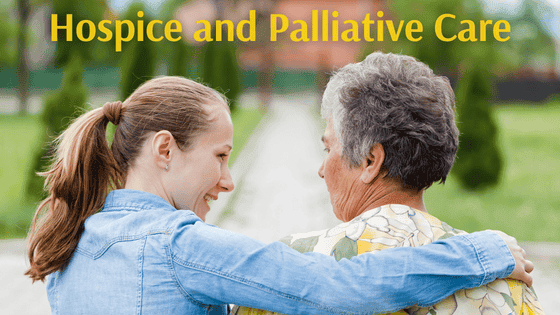
As I was preparing to graduate with my Master’s Degree in Social Work (MSW) with a concentration in Mental Health and Substance Abuse, I did not anticipate that my first post-graduate position would be in Hospice and Palliative Care. My in-field experience leading me to this point was focused on children and families in the foster care system, as well as working with severe and persistent mental illness in adults under the Community Mental Health umbrella. Working in gerontology was not a field in undergrad or graduate school that I would have ever considered. For eight years, I was employed as a Medical Social Worker. I provided treatment and support to patients and their families under the home care umbrella and in the inpatient Hospice Home for end-of-life care. I soon realized this field chose me, and I will be forever grateful that it did. The personal stories and experiences I had the privilege of hearing from this population were such a memorable learning experience for me in so many aspects of my life. It is not every day you can sit down with a WWII veteran and hear of their experience in the war and how they fought at the tender age of 18 for this country in unimaginable circumstances. This would be only one out of thousands of stories people shared with me at the end of their lives.
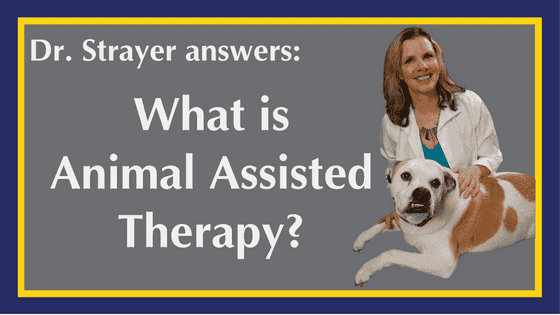
Hello! Let me introduce myself and then share the purpose of this article. I am Dr. Christina Strayer. I am the Instructor for the Telehealth Certification Institute’s Animal Assisted Therapy-Interventionist credential. As a person who has witnessed over and over the power of our connection with animals through the human-animal bond, I fell in love with the AAT field in the 1990s as I researched ways, while attending Radford University, to reach out to at-risk-youth and help them develop empathy, increase self-esteem and find purpose. I found the early work of Boris Levinson in his book, Pet Oriented Psychotherapy, and was fascinated by his case studies of how his pet dog, Jingles, prompted his clients to feel safe and explore their treatment goals in a fun, effective way. He had one young client who was diagnosed with selective mutism that began to talk to Jingles for the first time in session! I was sold!
What exactly is AAT?.....

In the years leading up to the pandemic, online learning was on the rise in the United States, as increasing numbers of students ranging from kindergarten to the postsecondary level were enrolling in virtual schools and online distance education programs. Covid-19 escalated this trend, and as it ushered in overnight school closures, the groundwork was laid for more deliberate and permanent changes to the educational landscape. Many states, recognizing the unique opportunities that the remote learning setting provides, began approving virtual academies and charter public schools to serve as state-funded educational environments. Some offer part-time hybrid models (with a mix of face-to-face and remote learning), while others offer fully online programs. As a result, many school counselors began offering virtual services and/or completely transformed their school counseling programs into virtual ones.
I have been a substance use counselor for nearly 17 years. When I started, a patient who used opioids or heroin was uncommon; now, if a patient has not used opioids or has never overdosed, we are mildly surprised. When suboxone (buprenorphine) arrived on the scene, we all thought our opioid crisis was over; little did we know. I was talking to one of my coworkers, who is friends with one of the local EMTs; she stated that our town has 6-10 overdoses daily. The population of our town is only around 100,000 people.
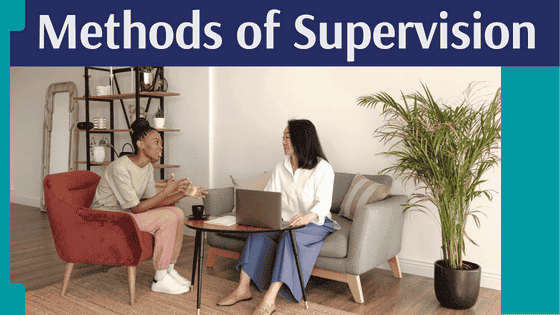
How are you, as a supervisor? This is a real question. Maybe an odd one, but a real question for an article on methods of clinical supervision. "Methods" are thought of as techniques we employ as a supervisor. While that is part of methods, supervision is multifaceted and involves other aspects for success. Method, paraphrased from the Merriam-Webster dictionary definition, is a procedure, way, or process for doing something. Therefore, methods of clinical supervision are not just specific techniques, such as "if I do … then …. will result". Methods include a process or practice of what is done to reach the goals of supervision. If you understand the what of supervision and the goals or purpose of it, then methods is the how or the intentional process of providing supervision, considering and combining techniques and our approach.
Clinical supervision increases professional development and competence. There are general goals and specific goals for each supervisee. Some common, general goals are increasing knowledge and developing skills, orientating to the profession and building professional identity, and gatekeeping for the profession. The result is having developed a person qualified for independent practice with diverse populations in various settings.
Operation Mind, Body, and Spiritual Resiliency
In the early morning hours of September 11, 2001, one of the largest person-made disasters in U.S. history took place killing nearly 3,000 Americans with over 6,000 others severely injured. Two jets crashed into the North and South Towers of the World Trade Center in Lower Manhattan hijacked by 19 al-Qaeda Terrorists. The Twin Towers collapsed in less than two hours. A third plane crashed into the Pentagon and a fourth plane, heading towards Washington D.C. crashed into a field in Stonycreek Township near Shanksville, PA. where several brave passengers blocked the hijackers’ efforts. This was the deadliest terror attack on U.S. soil in American history. Hence, the war on terrorism began.

What You Always Wanted to Know but Were Afraid to Ask
Perhaps nothing provokes more anxiety than the prospect or reality of facing a malpractice lawsuit or a licensing board complaint. As an attorney with almost 40 years of experience in representing healthcare and behavioral healthcare providers, I would love to offer you a foolproof way to prevent such events. Unfortunately, that is magical thinking. However there are many steps you can take to minimize your risk of exposure and to maximize your chance of a successful outcome if you are served with a lawsuit or a board complaint. Before providing you with a risk management toolkit, some background information and advice is essential.
Maximize your Insurance.

Many clinical supervision models identify 3 stages of supervisee development: Beginning, Middle, and Advanced. Motivational Interviewing (MI) skills are easily adaptable to these 3 stages of supervisee development and can help to provide direction for the clinical supervisor in the supervisory sessions.

The COVID-19 pandemic has been in place since March of 2020, almost three years. The majority of clinical social workers, and other mental health clinicians, have been providing mental health services virtually during this time. The initial switch from seeing patients in-person to seeing them virtually was a difficult one for many clinicians, even one that violated the way that some Codes of Ethics say that psychotherapy should be practiced.
The question of whether psychotherapy should be conducted through videoconferencing or audio-only platforms has shifted to whether it is safe to return to the office to provide the ever-increasing need for mental health treatment (from 20% to 50% of the country). About 30-40% of clinicians have decided to maintain their practices virtually and have given up their offices. For clinicians who have been debating whether they want to return to the office and/or are anxious to do so, there are several factors to consider, as follows:
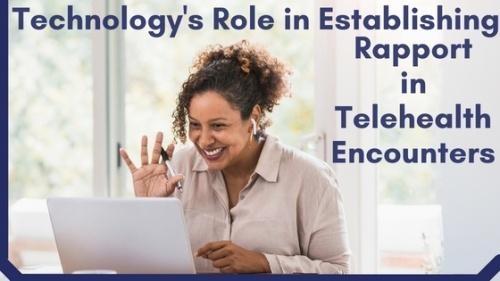
There are many factors that contribute to the success of a telehealth encounter, as there are many factors that contribute to the success of an in-person encounter. Ideally technology should not represent a barrier or challenge to conducting a successful telehealth visit, especially in terms of establishing a feeling of rapport between patient and provider. Technology is just the means to accomplish an end – providing effective and efficient healthcare to patients. The expectation that it is the same as in-person is misplaced as the expectation really is that it should be equivalent. It cannot be denied that the use of technology as a means of communication fundamentally changes the nature of an encounter. This change however should not be regarded as negative – there are actually some people who communicate better virtually than in person and vice versa. The differences between in-person and virtual encounters need to be acknowledged and participants need to be aware of these differences and learn how to adjust their actions and communication styles to accommodate the differences.
We've invited Terrance Williams, founder of Meta Wellness. His company provides virtual reality platforms for mental health professionals to host their Telehealth sessions in virtual reality. Terrance has been a pivotal pioneer in bringing Telehealth into the next stage of technology: Virtual Reality.
Meta Wellness specializes in creating virtual reality spaces for behavioral health clinicians and their clients in the metaverse. Terrance was inspired by the virtual reality space a couple of years ago. He wanted to make a valuable impact in the telehealth space by creating virtual reality platforms that were fun, challenging, and different. Terrance prides himself on making clients feel less shamed and judged in sessions within the creative digital spaces. He shared that a mental health therapist just recently thanked him for saving clients' lives by developing this innovative and interactive platform.
Like all behavioral health professionals, social workers are making increased use of technology to deliver services to clients, communicate with clients, gather information about clients, and educate students and practitioners. The advent of technology—including the Internet, text (SMS), email, video, social media and networking, cloud storage, and other forms of digital communication and software—has introduced novel and unprecedented ethical and risk management challenges. These dramatic changes in the ways that social workers use technology have led to major efforts to develop new standards in the profession. These efforts have occurred in three distinct, albeit related, domains: (1) practice standards, (2) regulatory and licensing standards, and (3) code of ethics standards. It is essential that today's social workers be thoroughly familiar with these significant developments to ensure that their practice complies with prevailing standards.
Testimonials
Iveyana Kiara Smith
Jessy Hainbach
Bryant Wilson
Ben Keyser
Mei Chan
Meghan Co, LCSW-C, LICSW