Becoming a Board Approved Clinical Supervisor in Arkansas is a significant professional milestone for Licensed Professional Counselors (LPCs). Approved clinical supervisors play a vital role in mentoring future mental health clinicians and ensuring high-quality counseling services statewide.

If you're an Arizona Licensed Professional Counselor (LPC) aspiring to become an approved clinical supervisor, understanding the Arizona Board of Behavioral Health Examiners (AZBBHE) requirements is crucial. Becoming an approved clinical supervisor enhances your professional credibility, expands your career opportunities, and positions you to mentor the next generation of mental health counselors.

Becoming an approved clinical supervisor is a significant career milestone for Licensed Professional Counselors (LPCs) in Alabama. Supervisors play a vital role in shaping the next generation of clinicians, promoting ethical practice, and advancing the counseling profession. If you're a licensed counselor in Alabama aiming to become an LPC-S (Licensed Professional Counselor – Supervisor), it’s essential to meet the state’s specific supervision training and continuing education (CE) requirements.
Becoming an approved clinical supervisor is a significant professional milestone for Licensed Professional Counselors (LPCs) in Alaska. Clinical supervisors play a key role in mentoring new counselors, ensuring ethical practice, and advancing professional standards. Telehealth Certification Institute, LLC (TCI) specializes in training Alaska LPC-S to meet the state's rigorous clinical supervision requirements.
As a Licensed Professional Counselor (LPC) in Georgia, your role as a clinical supervisor is critical in shaping the next generation of counselors. Becoming a Certified Clinical Supervisor enhances your professional credentials and enables you to contribute significantly to the mental health community. Telehealth Certification Institute (TCI) provides comprehensive training to help you fulfill the requirements to become an Approved Clinical Supervisor (ACS).
In the digital age, telemental health services have become increasingly prevalent, offering a convenient and effective means of therapy. As a behavioral health provider, it is crucial to consider not only the safeguarding of your clients' mental well-being but also their information security. This article explores the responsibilities of behavioral health providers in informing clients about protecting their data while using telehealth services.
We’ve invited Dr. Sheri Kingsdorf, an Assistant Professor at Masaryk University in the Czech Republic and a doctoral-level Board Certified Behavior Analyst (BCBA-D), to share insights on Applied Behavioral Analysis (ABA) interventions with families via telehealth, and how organizations can best prepare clinicians and families to use telehealth with great success. In a conversation with TCI’s Ray Barrett, Dr. Kingsdorf identifies the ways we can support families with children with neurodevelopmental conditions using telehealth.
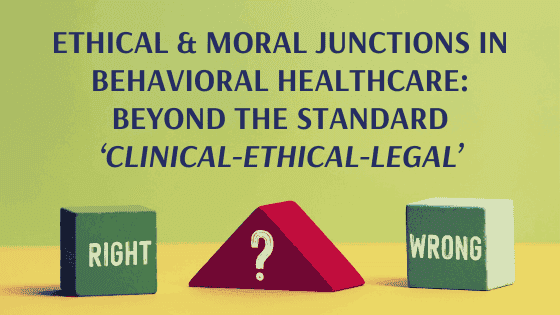
Expand the meaning of ethics in psychology and therapy beyond “codes of ethics” and clearly differentiate it from “risk management”
The following nine junctions serve to differentiate right vs. wrong and good vs. bad regarding suicidal client or therapist protection, lying to clients, clinically correct or false DSM DX, managing boundaries, digital immigrant therapists and digital native clients relationships, gender transition, opposition or advocacy for abortion in banned states, recommendation of psychedelics to patients, ethics of nudity between therapist and client.

The effects of COVID on telehealth have led to a viable and sustainable solution to many of the challenges facing healthcare delivery in the U.S. Virtual healthcare services are now one of the fastest-growing areas in the healthcare industry.
According to Centers for Medicare & Medicaid Services (CMS) reports, from March to October 2020, 68 million telehealth services were delivered, showing a 2,700% increase compared to 2019 reports.
We’ve invited Kathleen Shannon to discuss the process of pursuing multi-state licensure for licensed behavioral health professionals.
With the advent of telehealth, there are more and more possibilities for practicing in various areas. Some providers may have a particular niche with a demand for services. For others, continuity of care is essential. For example, Kathleen Shannon noted that when the pandemic started and some people had to move out of state, there were issues with providers not being able to continue care because they lacked licensure in the particular state. Ms. Shannon notes that complications arise as different states have varying regulations and requirements for licensure.
We’ve invited Dr. Tom Milam, the Chief Medical Officer for Iris Telehealth, to discuss approaches to addressing behavioral wait times. Dr. Milam has been a psychiatrist for over 25 years, and throughout his career, he’s seen many changes in the field and different approaches to care. He notes that there’s always been a shortage of providers for various reasons.

“Without some degree of regulation, it is difficult to connect with another person, and without connection, there is minimal reasoning. Regulate, relate, then reason.”
-(Perry & Winfrey, 2021; What Happened to You?)
One of the principles of a Trauma-Informed System (TIS) is Understanding Stress and Trauma (see here for a list of TIS principles). As clinicians, when we can understand the trauma and stress of our child and adolescent clients, we are more likely to act compassionately and take well-informed steps toward promoting our clients’ wellness. Our children and youth are more stressed than ever in the context of increases in certain mental health symptoms, including depressive symptoms and suicidal ideation; and increased psychological distress as a long-term impact of the COVID-19 crisis (see the U.S. Surgeon General’s Advisory here and the most recent CDC Youth report here).
Testimonials
Iveyana Kiara Smith
Jessy Hainbach
Bryant Wilson
Ben Keyser
Mei Chan
Meghan Co, LCSW-C, LICSW